Salamis is an extensive ancient ruin site on Cyprus's east coast north of Famagusta. The gymnasium, baths and partly restored theatre are particularly clear to understand. It rewards visitors who want to understand ancient urban life and allow time for a longer walk. Plan according to interest and temperature rather than trying to cover the entire site within a fixed minimum time. Travelling from the south requires a controlled Green Line crossing as a separate planning step. Current document and vehicle questions should be settled beforehand.
What distinguishes Salamis from a compact single ruin
At Salamis, you visit not just one monument but parts of an ancient city. Different buildings served different public functions. This perspective is more useful for an understandable tour than trying to date every visible wall immediately. Start with the site plan and decide which areas should be your group's focus.
Today's impression combines surviving remains, archaeological excavation and restoration. A fully upright column or row of seats therefore does not necessarily mean it has survived unchanged in that location since antiquity. To compare further cultural destinations, the overview of sights in northern Cyprus offers guidance. Salamis deserves its own sufficiently generous time slot within it.
Gymnasium and baths: view spaces through their functions
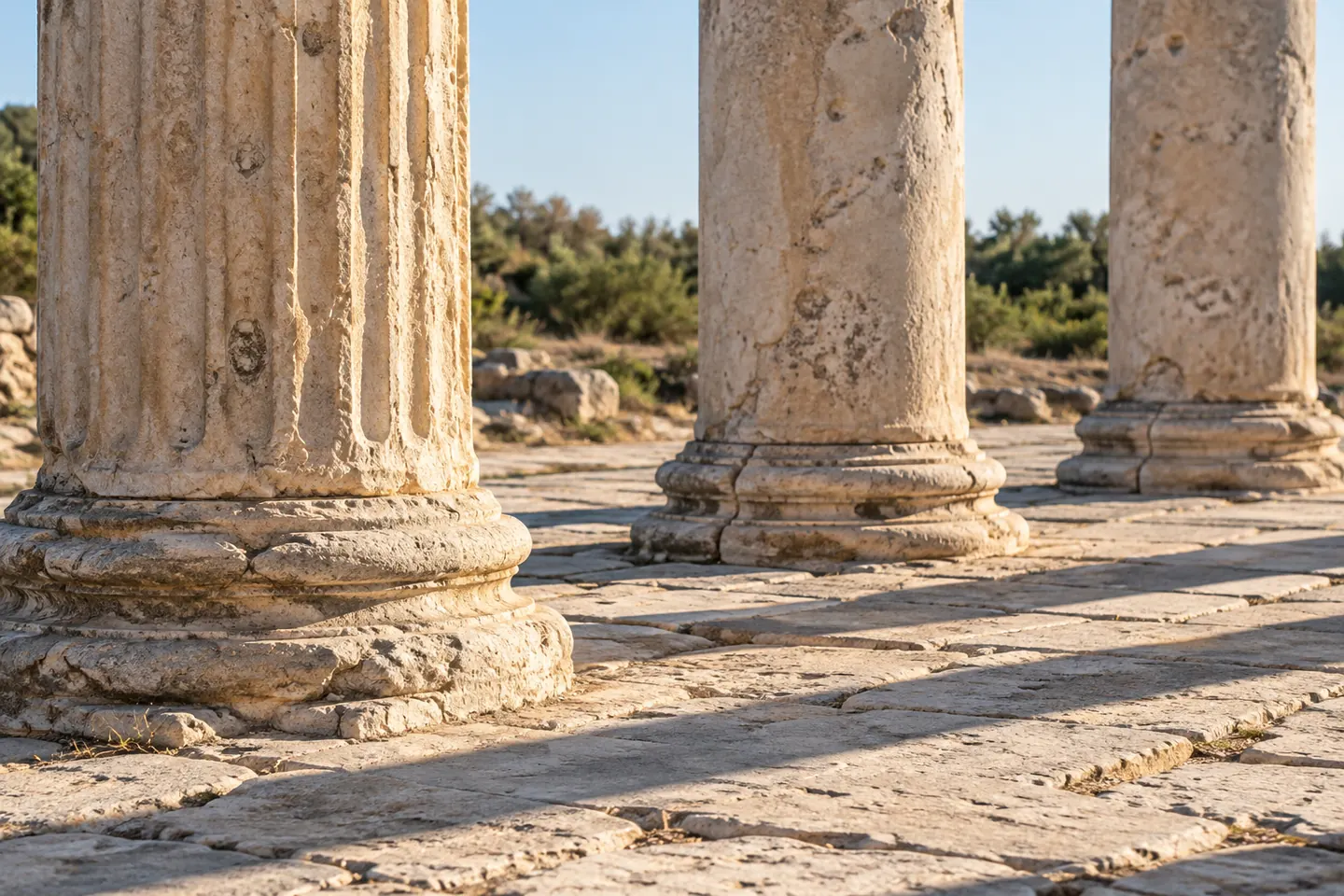
The gymnasium's colonnaded areas are among the site's most impressive sections. They offer a starting point for questions about training, social encounters and public life. The neighbouring baths add technical and social aspects. Look at the spatial connections between courtyards, water facilities and smaller areas rather than only photographing the grand view.
A site plan or explanation helps avoid confusing visible structures with modern concepts. An ancient gymnasium was not simply a modern school. Baths were likewise more than washrooms. Stay on permitted paths and do not touch fragile structures. An accessible comparison of individual functions is more useful for many visitors than a long list of uncertainly remembered construction dates.
The theatre and the question of reconstruction
The theatre conveys the scale of a public gathering and performance venue. Parts have been restored so the space can be experienced again. Distinguish today's impression from an assumed wholly original ancient setting. Look at shapes, sightlines and the relationship between seating and stage as far as accessible areas allow.
For photos, safety should come before perspective. Use only permitted steps and paths; a higher viewpoint is not necessary to understand the place. If you have already visited Kourion in southern Cyprus, compare the theatres' different settings. The aim is not to declare one site a winner but to appreciate different historical and landscape contexts.

Adapt your walk to time and temperature
For a first visit, the gymnasium, baths and theatre can form the core. Two to three hours is a sensible planning range if you want to absorb explanations and take breaks. Exploring more distant areas needs extra time and a closer check of the paths. A large site does not become manageable simply because every destination is on the same ticket.
In summer warmth, an early, time-limited walk is usually more pleasant than starting at the hottest time. Bring water, sun protection and sturdy shoes. Do not expect continuous shade. Agree a return point in advance if some people may want an earlier break. Photos and reading take longer than a simple overview; account for these different expectations before entering.
Arriving from the south and crossing the Green Line
For an excursion from the south, plan travel through an authorised controlled crossing. Check current German Federal Foreign Office guidance and the requirements applicable to your personal documents in advance. A hotel stay or residence entitlement in another country does not automatically answer these questions. Bring the required original documents.
For a rental car, clarify the rental company's permission and insurance cover separately. Additional insurance does not automatically replace permission to make the journey. Our guide to crossing in Cyprus brings together the essential planning questions. Also allow extra time for the crossing. Plan the return so that a longer stay or delay does not immediately clash with an important onward appointment.
Combine Salamis with Famagusta
The proximity of Famagusta and its old town makes the combination thematically interesting. Salamis represents ancient urban history, while Famagusta offers a later historic urban setting. Plan a genuine break between them rather than joining both walks without interruption. Especially on warm days, the total walking distance can be noticeable.
If you also want Varosha, the day must be deliberately limited again. It is a separate place with different historical contexts and access rules. An ancient site, an extensive old-town walk and another long visit are too much for many groups. Choose two main focuses or spread the destinations across several days so their differences remain clear.
Families, photographers and visits with limited walking
For children, a few guiding questions may be enough: where did people meet? Which buildings served leisure and community life? How was water used? Visible structures provide a starting point, while explanations should distinguish assumptions from established knowledge. Ruins are not a playground; walls and closed areas remain off limits even when obstacles appear low.
With limited mobility, clarify specific paths, surfaces and resting options before travelling. A large outdoor site is not automatically accessible everywhere. Photographers can focus on a few perspectives to gain more time for light and details. The Cyprus packing list helps assemble compact, practical equipment. Finally, check current opening and admission just before visiting; do not build the day plan around old prices.
Frequently asked questions: Salamis, Cyprus
How long does a visit to Salamis take?
Two to three hours is a sensible planning range for a selected walk covering the gymnasium, baths and theatre. Further areas, detailed explanations and photo breaks can lengthen the visit. Temperature and walking ability are decisive. Also allow for arrival, admission and a break outside the actual walk.
Can you visit Salamis and Famagusta in one day?
Yes, with suitable travel arrangements and a deliberately limited programme, this combination makes sense. Choose clear focuses in both places and allow time for a meal. Crossing the Green Line adds planning requirements. Add further major destinations only if time and stamina allow.
Is this the same site as ancient Salamis in Greece?
No. This guide covers the ancient city site in Cyprus north of Famagusta. It must be distinguished from the Greek island of Salamis and its associated historic locations. When checking maps, background information and routes, ensure they specifically refer to the Cypriot archaeological site.
Sources and further information
Editorial update: . Check opening hours, access and transport connections with the relevant authorities before visiting.