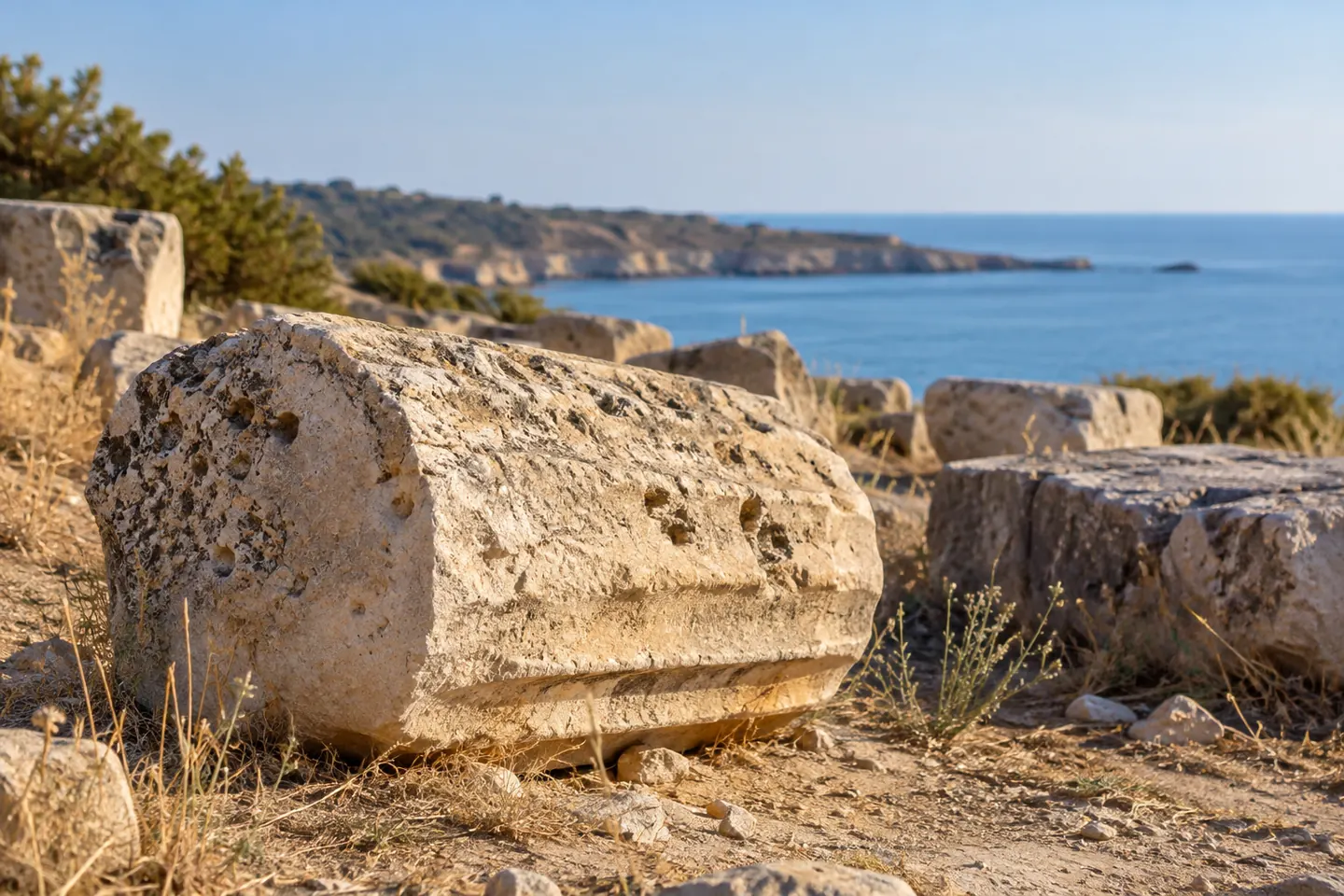
Kourion is an archaeological site west of Limassol, combining ancient urban history with sweeping coastal views. Highlights include the restored theatre, mosaics and remains of public and private buildings. For a first visit, a focused selection is more useful than trying to take in every piece of wall. As a personal planning recommendation, allow around two to three hours including breaks. With a clear route, sun protection and a little background knowledge, an attractive photo opportunity becomes an understandable insight into life in an ancient Cypriot city.
Understanding Kourion: more than a theatre with a sea view
Kourion was an important ancient city-kingdom. The remains visible today date from different periods, so they cannot be read as one unchanged cityscape. A useful starting point is to ask about functions: where did people gather, live, bathe and organise religious life? This puts the individual buildings into context.
Start by looking at a site plan and choose three or four main points. If architecture is your main interest, examine floor plans and sequences of rooms. If you are travelling with children, the theatre, baths and mosaics offer tangible stops. You do not need to remember many dates. It is more useful to recognise differences between private housing, public infrastructure and later uses.
The theatre: an ancient site still used today
The theatre is one of Kourion's best-known sights. It has ancient origins, was enlarged in Roman times and later restored. Its present appearance is therefore not simply that of a completely unchanged surviving structure. This distinction matters: restoration helps convey the space, but should not be confused with an untouched original condition.
First take time to look across the seating rows from a permitted viewpoint. Then notice the relationship between stage, auditorium and landscape. Stairs and stepped seating can be demanding for people with reduced mobility. You do not need to negotiate every change in level to understand the site. If events or works restrict certain areas, adapt your route rather than expecting unrestricted use.
Mosaics and the House of Eustolios
The House of Eustolios illustrates the connection between domestic life, mosaic decoration and baths. The building changed during its use. Notice how different rooms connect and view the mosaics from the designated visitor areas. The roof protects fragile remains and also highlights how much conservation work a site like this requires.
Other well-known mosaics are associated with the Houses of Achilles and the Gladiators. These names refer to the subjects depicted and help orientation. Do not use them to invent unverified biographies of former residents. Instead, compare figures, patterns and composition. When taking photographs, follow local rules and avoid blocking narrow passages. Looking carefully at one detail often offers more than a quick series of every picture panel.

A walking route to suit your available time
For a compact first visit, the theatre and House of Eustolios can form the core. Then add one selected part of the ancient city. With a stronger interest in archaeology, you can explore the other houses, public spaces and early Christian basilica in greater depth. The exact order depends on open access points, path conditions and your fitness on the day.
Where possible, do the more demanding walks at the beginning and allow a break before concentration fades. A longer route is not automatically better. Discuss beforehand whether the group will see everything together or meet again at agreed points. Visitors taking photographs or reading information panels in detail often need more time than a simple walk-through route suggests.
- Compact: theatre and one selected mosaic area.
- More detailed: additional city areas according to your interests and open paths.
- With children: a few stops with vivid questions rather than as many facts as possible.
- With reduced mobility: clarify specific access beforehand and avoid stepped routes.
Practical preparation: heat, paths and accessibility
Large parts of an archaeological site are exposed to the weather. Bring water, a hat and appropriate sun protection. Sturdy, comfortable shoes help on uneven paths. In warmer months, an early start is often more pleasant, while on cooler days wind can be noticeable across the open grounds. The actual forecast and your personal stamina are what matter.
Visit Cyprus describes Kourion as partially accessible. This does not imply full accessibility throughout every building. If needed, ask specifically about the current route from the car park to your chosen areas, steps and available facilities. Admission prices and opening hours can change, so they are not given here as fixed guarantees. Before travelling, also check notices about works, special events or temporarily closed sections.
Which destinations combine well with Kourion?
Kourion makes a suitable cultural centrepiece for a day from Limassol. Follow it with a relaxed coastal break or time in the city. If continuing towards Paphos, you can include Aphrodite's Rock as an additional scenic stop. Allow enough time between destinations so that sightseeing does not become a duty to complete before the next drive.
The Sanctuary of Apollo Hylates and other ancient sites nearby are destinations in their own right. Check their access and visitor information separately rather than assuming they are automatically part of the same route. For a holiday with several excursion days, a clear focus is especially useful: Kourion one day, Paphos and its other archaeological areas on another. This keeps impressions distinct and journeys manageable.
A different thematic addition in the region is Kolossi Castle; the medieval building can be deliberately chosen as a separate focus alongside the ancient city.
Frequently asked questions: Kourion Cyprus
How long does a visit to Kourion take?
For a first visit, around two to three hours is a useful personal planning allowance. This is not an official minimum duration. The theatre and a selected mosaic area can be viewed more briefly, while a detailed archaeological walk takes longer. Allow more time in heat, with reduced mobility or frequent photo stops, and add travel time separately.
Is Kourion interesting for children?
Yes, if you focus the visit on a few tangible questions: how did a theatre work, what were baths for, and what stories do mosaics tell? Long explanations for every ruin are often less helpful. Choose short stages, watch exposed edges, and plan water and a break outside the midday heat.
Are the Tombs of the Kings in Paphos part of Kourion?
No. Kourion lies west of Limassol; the Tombs of the Kings are in Paphos. Both are archaeological attractions, but belong to different locations and visiting programmes. Check tickets, routes and opening hours separately for each. For a relaxed trip, it often makes sense to visit the two sites on different excursion days.
Sources and further information
Editorial update: . Check opening hours, access and transport connections with the relevant authorities before visiting.