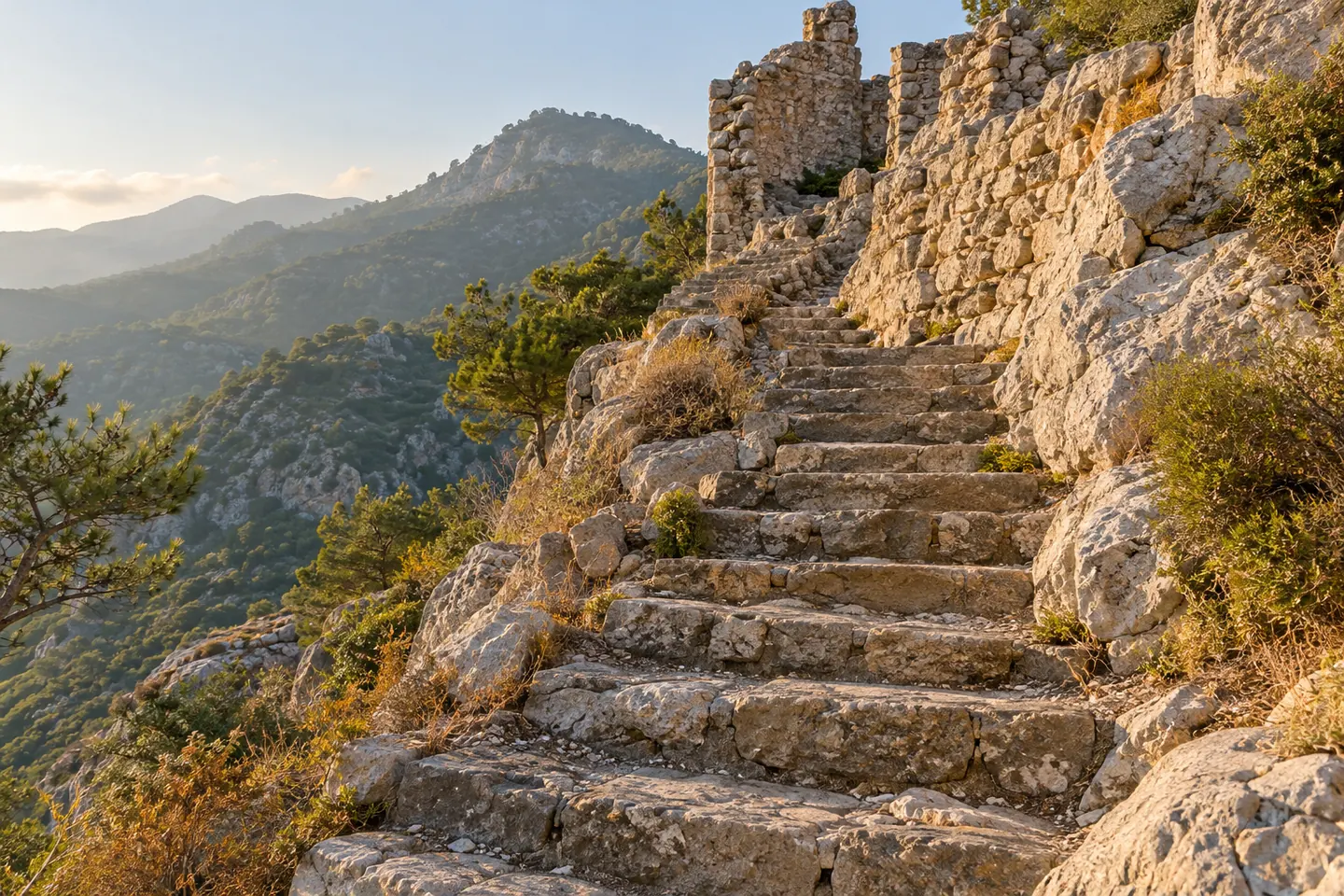
St Hilarion Castle is worthwhile for visitors who want to combine an impressive mountain fortress with an active walk. It lies in the Kyrenia Mountains in northern Cyprus and is spread across three levels. The climb involves numerous steps, some steep, so a simple photo stop hardly does the site justice. Allow around two to three hours as a personal reserve for exploring, breaks and the descent. What matters is your sure-footedness, conditions on the day and a realistic choice of accessible sections, rather than reaching the highest point at any cost.
What to expect at St Hilarion
The castle's location immediately explains its former role: mountain routes and the coastal landscape lie below the fortifications. A complex of Byzantine origins developed under the Lusignans into a fortified residence for the nobility. Today you visit a ruin with surviving walls, rooms and passageways, not a fully furnished palace.
At the start, take time to look at the whole complex. Where were the living quarters, where could provisions be stored and how were the different levels connected? These questions make the visit interesting even without extensive prior knowledge. The history becomes clearer through building forms and terrain than through a long list of rulers. The local information boards help distinguish later alterations from older sections.
Three castle levels with different focuses
The lower section was used, among other things, for supplies and accommodation. The middle level contains remains of various living and communal rooms and the church. Higher up are further residential areas and viewpoints. This layout provides a sensible order for visiting, but does not mean that every area is fully accessible at all times.
First explore the open lower and middle sections before deciding on the final climb. If you are already tired there, you have still gained a meaningful impression of the castle. A visit need not be a sporting test. For children travelling with you, cisterns, doors and stairs may be more vivid than precise dates: think together about how water and food reached the mountain. Wall remains and closed entrances are not climbing areas.
How strenuous is the climb?
The challenge lies less in a long walking distance than in the succession of steps, uneven stone and narrow passages. The descent also demands concentration and puts strain on your knees. Keep your distance on narrow sections and let other visitors pass at suitable places. Take photographs while standing in a safe spot, rather than looking at your screen as you walk.
The castle is not suitable for pushchairs or a completely step-free visit. If you have reduced mobility, ask specifically which areas are accessible rather than judging access from photographs alone. For history without a longer climb, Kyrenia's harbour and old town offer other options. Discuss beforehand whether everyone in your group wants to visit the same levels.
Consider the time of day, heat and weather
In warm weather, an early visit is usually more comfortable, allowing you to do the strenuous part before a long midday break. Altitude does not guarantee cool conditions. Include water, a hat and sun protection in your day kit. Carry a small backpack rather than a bag you have to hold constantly on the stairs.
Rain can make stones slippery, while wind affects the visit particularly in exposed areas. Decide whether to climb further according to the actual conditions. Cloudy views are no reason to seek out unprotected vantage points. The overview of the best time to visit Cyprus helps with seasonal planning. Also check the castle's specific opening and access information immediately before your excursion.

Travelling from the south and allowing time to return
For a day trip from the south, controlled crossings of the Green Line form part of the planning. Check current official guidance for your nationality and carry the required valid original documents. A German residence permit does not automatically satisfy the requirements for travellers of other nationalities.
For a hire car, clarify the rental company's permission and actual insurance coverage separately. Additional third-party liability insurance does not mean damage to your own hire car is also covered. The travel guide to crossing the border in Cyprus explains these issues. Respect military areas and photography bans along the approach. Allow enough time after your visit for the descent, return journey and possible waits; a flight that same afternoon is not a suitable tight connection.
Combine St. Hilarion with Kyrenia or Bellapais
For a balanced day, choose a second main destination alongside the mountain castle. Kyrenia complements the stone stairways with harbour atmosphere and a meal break. Bellapais, with its abbey and village, suits an interest in architecture but requires more time on foot. Visiting all three places thoroughly may be too much, especially with a longer journey to get there.
A sensible itinerary would be the castle in the morning, followed by a longer break and then a limited walk around the second destination. Decide beforehand which stop to omit if you become tired. For travellers with very different interests, a smaller selection often works better than a tight three-stop schedule. Add museums or shopping stops only if there is genuinely time available, not merely an apparent gap on the map.
Turn the visit into a rewarding excursion
Pack lightly but purposefully: enough drinking water, a small snack, sun protection and a charged phone. Save your meeting point with fellow travellers so it is easy to find. If the group splits up, agree both a place and a time; the different levels are not a good setting for spontaneous searches.
Start with a shared overview, then follow individual interests. Photography enthusiasts can focus on a few carefully chosen viewpoints. History lovers may explore rooms and supply facilities, while others enjoy the landscape. These different interests combine well as long as the return journey is considered. At the end, check water supplies, energy levels and the time of day before adding another sight. The castle leaves a lasting impression when the visit is not immediately followed by a rush.
Frequently asked questions: St. Hilarion Castle
How long does a visit to St. Hilarion Castle take?
For planning purposes, around two to three hours including breaks and the descent is a useful allowance. This is not a fixed walking time. Photography, visitor numbers, heat and the levels you choose affect the time required. If you visit only the lower areas, you can stay for less time; allow plenty of margin for the full ascent.
Is St. Hilarion suitable for children?
The visit can interest sure-footed children who enjoy castles. Adults need to stay close on stairs and in open areas. The excursion is not pushchair-friendly, and the full ascent should not be compulsory. Choose the extent and time of the visit according to your family's ages, the weather and stamina.
Is St. Hilarion included in every Kyrenia tour?
No. A tour to Kyrenia or Bellapais does not automatically include the mountain castle. Its additional time, access route and physical demands must fit the day's plan. Clarify specifically whether St. Hilarion can be part of an individually tailored route and which other stop would be omitted.
Sources and further information
Editorial update: . Check opening hours, access and transport connections with the relevant authorities before visiting.